• Home
  • Completed Costumes/Impressions
  • Emma and Her Dresses
  • Free Patterns and Instructions

Kitty Calash

~ Confessions of a Known Bonnet-Wearer

Kitty Calash

Category Archives: Fail

Fitful Friday: Art Still Has Truth

20 Friday Jan 2017

Posted by kittycalash in Clothing, Fail, Frivolous Friday, Historical Sew Fortnightly, Making Things, personal, Philosophy

≈ 7 Comments

Tags

empathy, fortitude, interpretation, living history, Making Things, projects, sewing

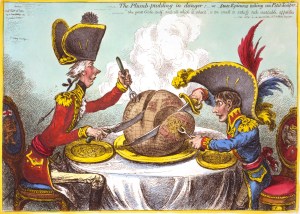
Pitt and Napoleon carve up the world.

Pitt and Napoleon carve up the world.

It’s been one of those weeks, hasn’t it? Up and down, emotionally, as we all prepare for change. Whig or Tory, these are turbulent times.

I’ve been surprised by recent fabric arrivals in the mail, disappointed when I waited a day too long to register for a dance, and now I’m at loose ends. What comes next?

dscn4579
dscn4588

Last weekend I cut out a black wool Spencer to line in lettuce green silk because why not? And teeny tiny backstitches later, I have one sleeve finished. Focus is hard to come by of late.

I meant to join the Historical Sew Monthly to give my sewing life some structure, and I still can, though I cannot seem to settle down. Clearly, I have Firsts & Lasts that could be made (not always in the time remaining, mind you, so I would have to choose wisely).Re-Make, Re-Use, Re-Fashion? Probably much there as well– at least if one counts the quilted petticoat worn at Princeton, which was remade and altered from its original form.

Red. I do love red.
Red. I do love red.
Delicious wool, tasty price.

July: Fashion Plate, could become the shawl gown I’ve dreamt of for years, since, as you can see above, I’ve found one that might work, lured by a fair price on a sizable piece of wool– but wherever shall I wear it? Why can I not get past utility? The Dreamstress’ Kashmiri shawl gown and her research are there to emulate, and explain.

Oh, I have projects and events to research and plan, housework to complete, and plans to execute. But they all seem abstract and unreal at the moment when we hang on the pivot point between the future and the past. It’s been a strange year in many ways and places, and constructive projects help focus.
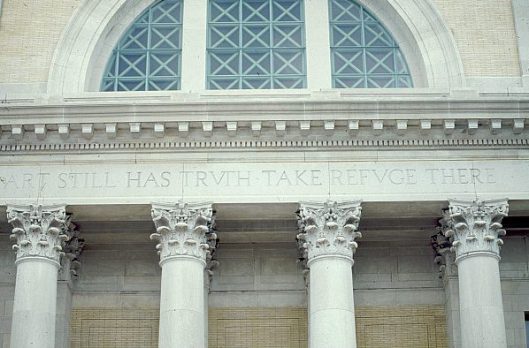
Art Still Has Truth Take Refuge There

Art Still Has Truth Take Refuge There

Long ago, in the first turbulent times I was old enough to understand, I lived in St. Louis. Then, as now, I think the Art Museum’s motto holds, and reminds those of us who work in or appreciate sometimes frivolous-seeming fields and hobbies that all our actions have meaning. I’ve thought for a long time about the utility of sewing historic clothing, cataloging objects, and running around recreating the past.

Getting outside one’s own experience is incredibly hard; it’s hard to have an open heart, and to encourage openness to others. But that’s one of the most important roles museums and libraries play: we help people develop imagination and empathy. I know it’s part of why I do the work I do. I like to think that ultimately, helping illuminate the complexity of the past will help us all understand the present and make a better future.

Share this:

  • Click to share on Facebook (Opens in new window) Facebook
  • Click to share on Pinterest (Opens in new window) Pinterest
  • Click to email a link to a friend (Opens in new window) Email
  • Click to share on X (Opens in new window) X
Like Loading...

Museum Fail: Icon, not Replica

21 Wednesday Dec 2016

Posted by kittycalash in Art Rant, Fail, History, material culture, Museums

≈ Comments Off on Museum Fail: Icon, not Replica

Tags

authenticity, collections, difficult interpretations, exhibits, interpretation, material culture, Museums, National Marine Corps Museum, objects

img_8606

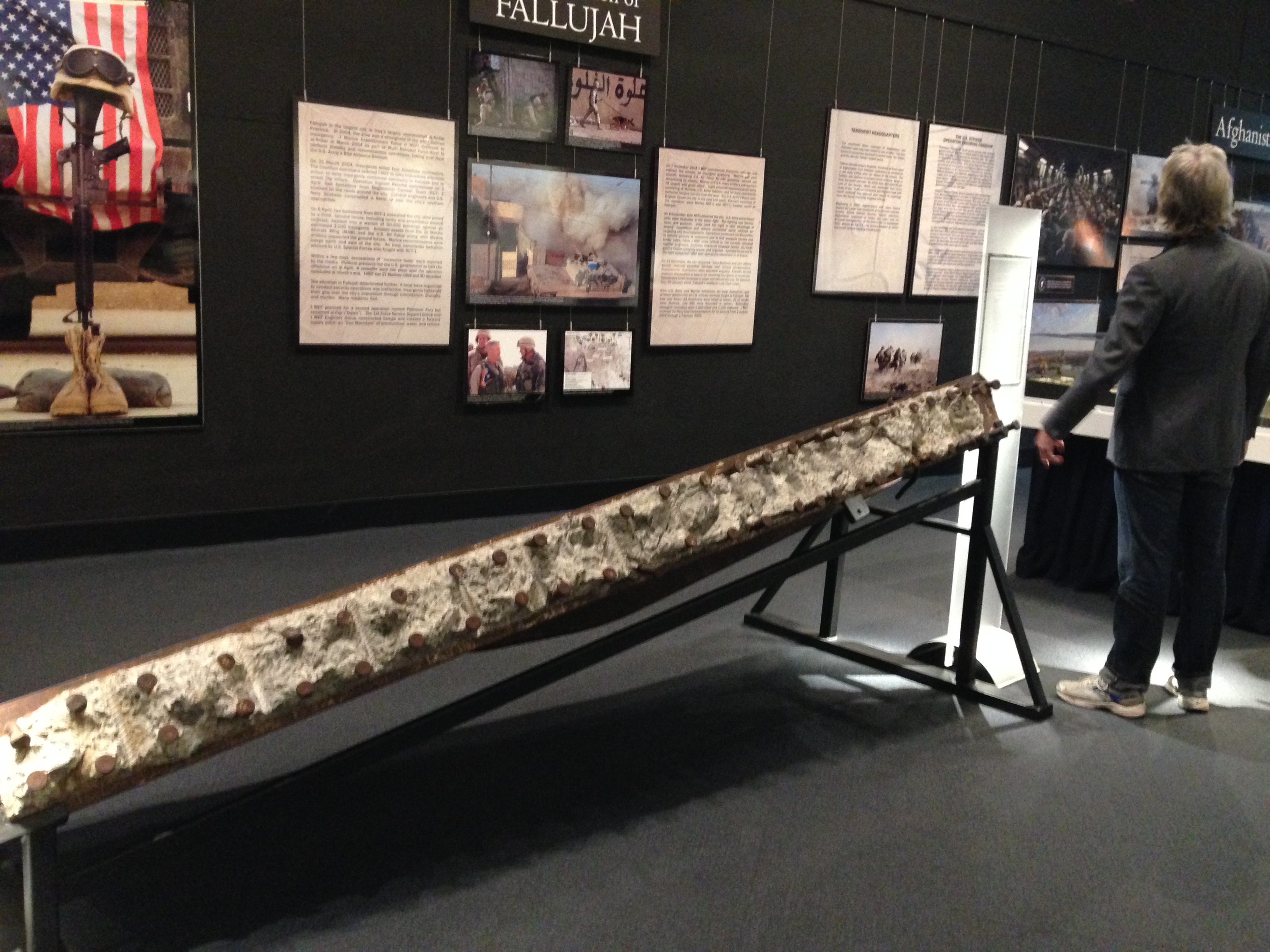
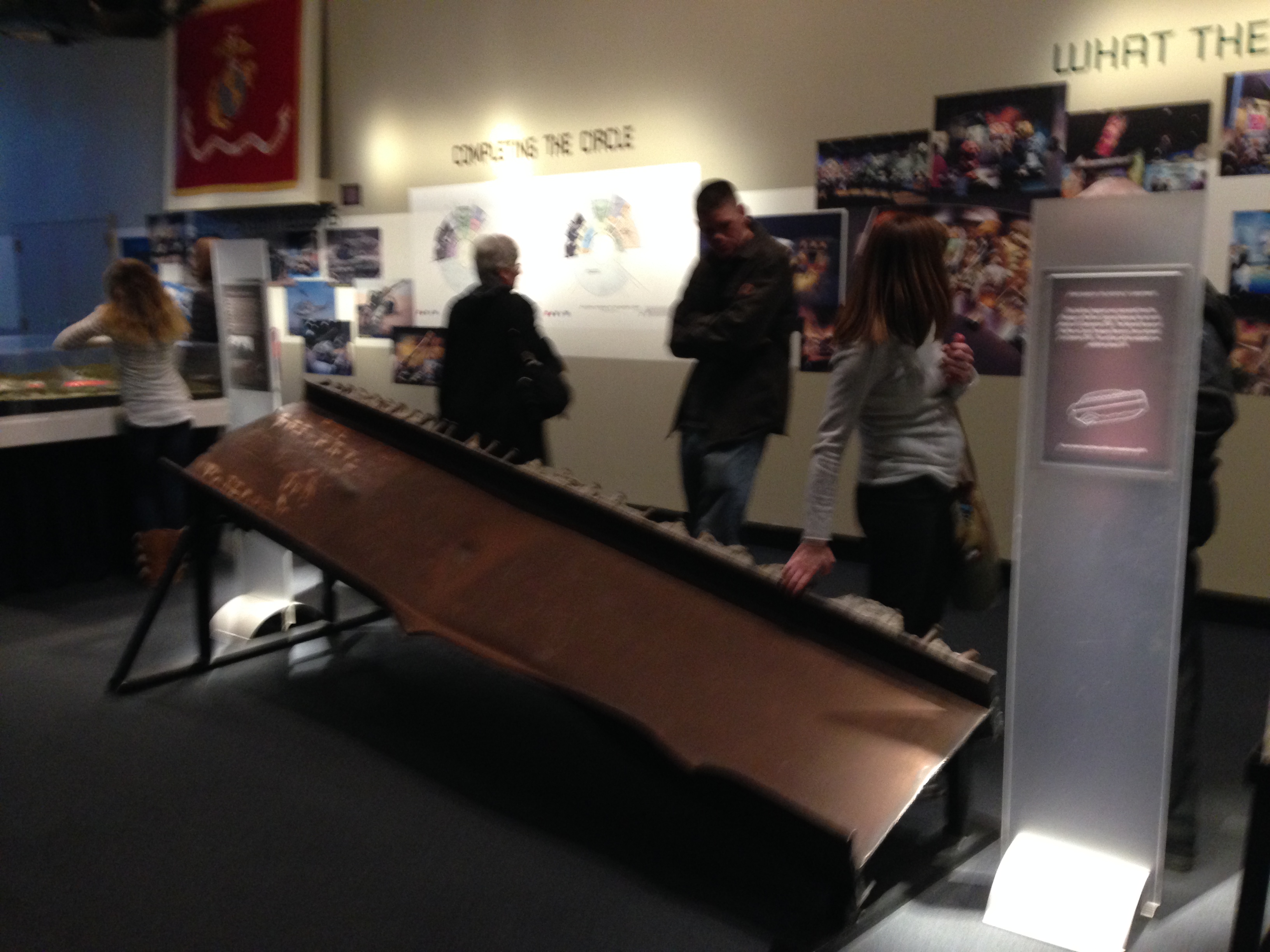
What am I?

Do you know what this is? Do you think it’s real? Here’s a clue: it’s a relic of an iconic event in early 21st-century North America.

On the last visit to the National Marine Corps Museum, I watched the tourists circle objects at the end of the traditional galleries and displays, and overheard a woman ask her companions:

What’s this a replica of?

Reader, I cringed– and not for the sentence construction.

What's this a replica of?

What’s this a replica of?

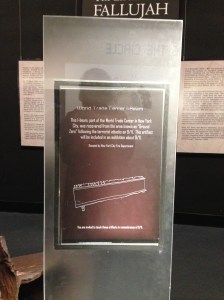
And then I stepped back. I thought that for someone my age it would be obvious. Here, have some additional museum context.
img_8604

In a museum where everything is real, how does a visitor come to ask not only if that World Trade Center steel beam is a replica, but what is it replicating? I’m not sure semiotics can save us here. My first, New York Times-reading, media-soaked, Northeast Corridor response was, How can you miss that? How can you not recognize that, let alone mistake the steel and concrete relic for a replica?

img_8603

Ah, hubris. There is a label, though I have seen better. Would it be more helpful in a larger font, turned perpendicularly to the I-beam? Possibly. But the lesson that’s deeper than label formatting and placement is recognizing how much we take for granted. Our visitors, even those we assume to be educated consumers of media and information, may not share our knowledge base. They may not read objects or images as readily as we think they do; we certainly cannot assume they’re all taking away the same information– and that has nothing to do with education or background.

Everyone truly sees the world differently. How, and what, we choose to put on a label should always be grounded in remembering that we do not all share the same information. Context is critical, and probably would have made these relics more real, and less replica.

Share this:

  • Click to share on Facebook (Opens in new window) Facebook
  • Click to share on Pinterest (Opens in new window) Pinterest
  • Click to email a link to a friend (Opens in new window) Email
  • Click to share on X (Opens in new window) X
Like Loading...

Hell is a Hand Basket

15 Thursday Sep 2016

Posted by kittycalash in Art Rant, Clothing, Fail, History, material culture, Research

≈ 5 Comments

Tags

18th century, 18th century clothes, art history, authenticity, baskets, Costume, dress, fashion, interpretation, John Copley, john smibert, Joseph Blackburn, portraits, Research

Gentle Reader: Remember the post on semiotics? We need to go back to that once more.

Just what are we looking at here?
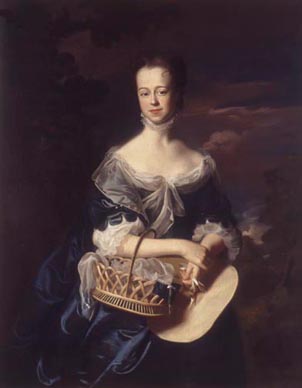
copley_john-singleton-mrs-daniel-rogers-middleton-collection

John Singleton Copley.
Portrait of Mrs. Daniel Rogers (Elizabeth Gorham Rogers), 1762
50 X 40, oil on canvas.
Middleton Collection, Wake Forest University
HC1991.1.1

Hmm…. 1762. Does that dress look like 1762 to you? Or does it resemble a 17th century garment? Check out those sleeves: scallops. The shift sleeves: super full. The line of the gown at the neck: a shallow scoop. The front of the bodice: closed.

Are those the hallmarks of a typical 1762 gown in New England, England, or France? You are correct, sir: They are not.

What’s happening here? What is Copley doing, and why?

He’s making his subject look good, reflecting her wealth and status. He’s flattering her by painting her in a faux-17th century gown, a “Vandyke costume, a popular artistic convention in England related to the vogue for fancy dress and masquerade.”* 1762 seems a trifle late for this convention, but in 1757, James McArdell produces a mezzotint of Thomas Hudson’s portrait of the Duchess of Ancaster. Henry Pelham wrote to Copley in 1776 that he had purchased one of those mezzotints, suggesting their use as references for Colonial American painters. Reynolda House has a nice explication of this style of dress in the Thëus portrait they own of Mrs. Thomas Lynch, shown below.

Mrs. Thomas Lynch, oil on canvas by Jeremiah Thëus, 1755. Reynolda House, 1972.2.1

Mrs. Thomas Lynch, oil on canvas by Jeremiah Thëus, 1755. Reynolda House, 1972.2.1

There was also a convention of portraying women in “timeless draperies,” following the school of Peter Lely and Godfrey Kneller, both late 17th-century English painters who produced portraits with generalized costumes.

Lady Mary Berkely, wife of Thomas Chambers. oil on canvas by Sir Godfrey Kneller, ca. 1700. Metropolitan Museum of Art, 96.30.6

Lady Mary Berkely, wife of Thomas Chambers. oil on canvas by Sir Godfrey Kneller, ca. 1700. Metropolitan Museum of Art, 96.30.6

This portrait by Kneller (born in Germany, he worked in England) explains a lot, doesn’t it? And this timeless convention persists for some time, and the stylization of the facial features and hair is copied by English and colonial American painters. John Smibert, long familiar to many of you, was a leading practitioner of this style of portrait, and his work would have been well known to Copley and his sitters.

Mrs Samuel Browne by Smibert, RIHS 1891.2.2

Mrs Samuel Browne by Smibert, RIHS 1891.2.2

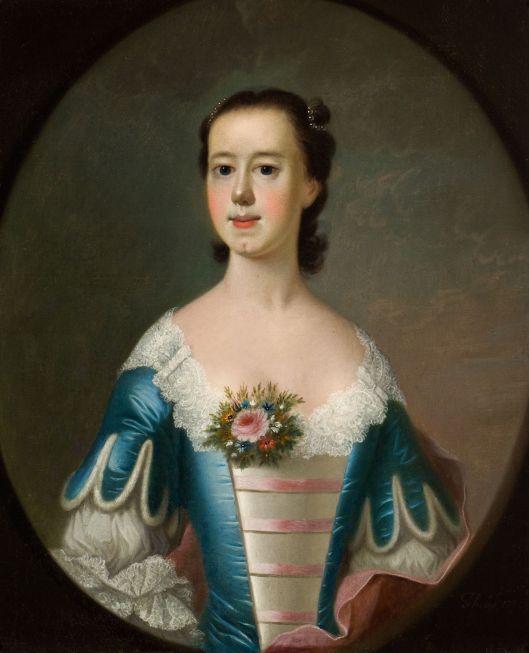
Blackburn’s portrait of Mary Sylvester adopts two conventions at once, in a way: she’s in timeless-style drapery and fancy dress as a shepherdess. Let’s remember, too, that there’s symbolism in the shepherdess imagery, referencing pastoral innocence and Mary Sylvester’s unmarried, presumably virginal, status. Don’t believe me? Read the catalog entry, written (at the very least) under the supervision of actual, degree-toting art historians.

Mary Sylvester, oil on canvas by Joseph Blackburn, 1754. Metropolitan Museum of Art, 16.68.2

Mary Sylvester, oil on canvas by Joseph Blackburn, 1754. Metropolitan Museum of Art, 16.68.2

Where does that leave us with Mrs. Rogers? She’s portrayed in what is essentially fancy dress, holding her straw hat in her left hand (much as Mary Sylvester is) with a basket over her right forearm. You will note the open work of the basket, the delicate arches and the fineness of the base. What’s in it? Something gauzy, as light as the drape around her shoulders, with a square of dark blue silk and a fine white silk ribbon. Honestly I am not entirely certain — the resolution of the image is dreadful.

But what’s NOT in the basket? A redware or pewter mug, sewing, keys, bottle, food, candy, toys, or, really, anything of a very concrete or practical nature.

Is this image a justification for carrying a [nearly empty ] basket on the streets of Boston? Of course it is–as long as you justify walking the streets of Boston in imaginary or fancy dress.

*p.106, Ribeiro, Aileen. “‘The Whole Art of Dress’: Costume in the Work of John Singleton Copley.” John Singleton Copley in America, Metropolitan Museum of Art, 1995.

Share this:

  • Click to share on Facebook (Opens in new window) Facebook
  • Click to share on Pinterest (Opens in new window) Pinterest
  • Click to email a link to a friend (Opens in new window) Email
  • Click to share on X (Opens in new window) X
Like Loading...

Serious Saturday: Security Concerns

09 Saturday Jul 2016

Posted by kittycalash in Fail, History, Museums, personal

≈ 1 Comment

Tags

historic house museums, Museums, preparations, safety, security, work

Warning: Museum Content Ahead

Woman Selling Salop. William Henry Pyne. The Costume of Great Britain. 1805.

Woman Selling Salop. William Henry Pyne. The Costume of Great Britain. 1805.

Night watchmen. We’ve been over them before, tangentially, but never in an experienced way. Sure, sleeping overnight at museum sites, I’ve encountered the night watchman making his rounds. And as a museum visitor, I’ve met the guards who monitor how I’m wearing my messenger bag, and how close I get to various works of art.

But what I don’t think about enough, and don’t observe being thought about, is the safety of people over objects. The Museum Security Network has posts on art theft, forgery, and vandalism— all of which are important topics– but there’s a clear focus. For years, decades, that was our focus at work: stuff, buildings, not people.

That changed in our Library five years ago with one obstreperous patron who touched–didn’t hurt, but was angry, and put a hand on– one of our librarians. Now we think about books, papers, and people. But it’s hard: for as long as I’ve worked in this field, and it’s fully half my life, I’ve had the mission drummed into me: access. We preserve these materials, these objects, these sites, for the use and enjoyment of the public, and that means everyone.

The radical democracy of object care (everything we own is preserved with the best care we can provide, from 17th century basket to 21st century advertising hard hat) translated for me into the radical democracy of access: everyone gets in. (It helps that I’ve worked at places where we could provide a lot of free access, and where we continue to strive for as much free access as possible.)

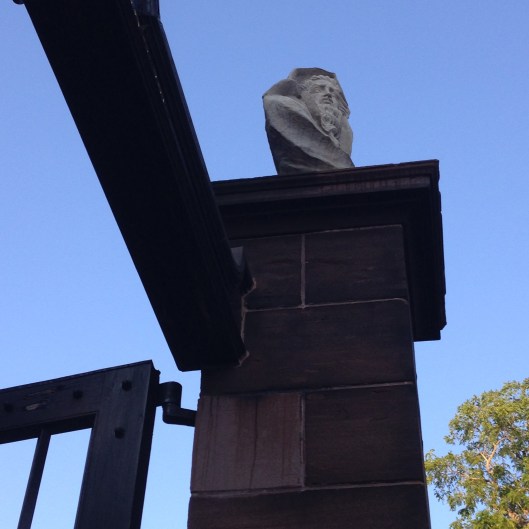
Hades atop the front gate pillar

Hades atop the front gate pillar

Everyone gets in. Everyone can appreciate our shared cultural heritage. And then I met Mr Hades. That’s not his real name, but the young man who has been visiting us at the museum (after coming to the library last summer in a quieter mode) has developed an obsession with Hades. He came in Thursday, asking about the front gates, about Hades being the god of Hell, and whether the gates of hell were in our basement. I’ve heard a lot of myths about our basement, but not that one. After ten minutes, and before we could connect to 911, Mr Hades left.

But he was back yesterday, more erratic than before, sunglasses hiding his wide and striking pale green eyes, ranging through the house from front to back streaming a rap song on his phone. He paid for the tour, but left after 10 minutes in the house. He’s clearly been on a tour before.

So we met two police officers from the local substation, and we know to call them immediately if Mr Hades returns. A little research (that’s what we do) turned up a lot of interesting information about Mr Hades, and we suspect that there are officers and judges and guards who are pretty familiar with him, and that he needs help as much or more than he needs incarceration. But he disturbs our visitors, and agitates the staff, and that’s a bad visitor experience. (Thanks to my anti-anxiety meds, I don’t get anxious; I just get a stomach ache and keep talking with Mr Hades to try to keep him focused.)

But last night, talking about safety and Mr Hades with Drunk Tailor, I realized that we don’t think enough about the security of our staff. We put our visitors and our objects before the staff, and that’s not right. This incident made me put the safety of our staff above that of the objects, but we can’t help our visitors be safe unless we take care of ourselves.

oxygen-mask

If your staff members know their routines, know how to respond and have the tools they need to respond, they’ll be better able to care for and direct visitors to safety. I know we have to shift our thinking and procedures where I am; chances are your procedures are up for their annual review, too. For many of us, the new fiscal year has just begun. What better time for review and changes?

Share this:

  • Click to share on Facebook (Opens in new window) Facebook
  • Click to share on Pinterest (Opens in new window) Pinterest
  • Click to email a link to a friend (Opens in new window) Email
  • Click to share on X (Opens in new window) X
Like Loading...

Indocent Exposure

28 Tuesday Jun 2016

Posted by kittycalash in Events, Fail, History, Living History, Reenacting, Thanks

≈ 2 Comments

Tags

18th century, authenticity, common people, common soldier, Events, interpretation, living history, New Jersey, Revolutionary War

IMG_7288 Or, Confusion into Confusion.

Docents and volunteers: the backbone of any non-profit organization, right?

Well…sort of. I’ve worked with docents for more than a decade, and along the way I’ve learned what does and doesn’t work. What does work is intensive engagement and participation, though the occasional shock to the system can be necessary and useful. For special events, though, and in cases of turf, diplomatic relations must be opened with the enemy early and often.

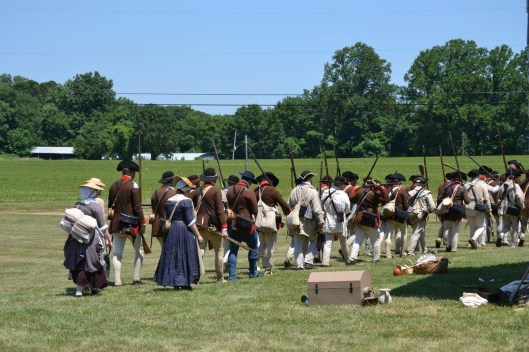
That is not to fault the organizers of the “Order Out of Confusion” event this past weekend, for I was one of the people organizing the civilian, non-marching end of things, and due to turbulence in my own life, I failed to plan adequately in the arena of Docent Relations.

IMG_7296

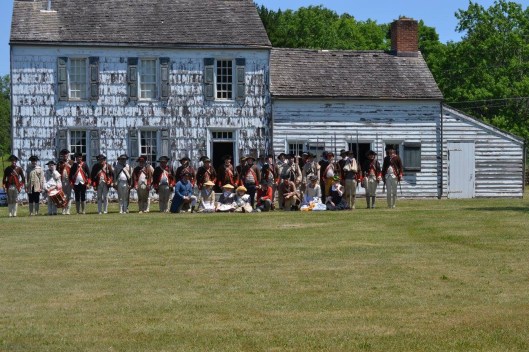
We had a Retaliator, a Pine Robber, a Quaker, and a Slave-Owning Patriot. We managed a debate or two over slavery. We begged people to take the Quaker home with them. But we did not occupy the house, for the house was occupied by red-shirted volunteers who gave at least some of us the five cent Condescension Tour punctuated with, “But I suppose you’re not interested in that.”

IMG_7298

Actually, that look was one of sheer disbelief, sir, at the farm implements in a bedroom, the tidy piles of perfectly formed ashen coals under the cookware in the fireplace, and the roomful of flax accented with a snake charmer’s basket. In my line of work, I enjoy house tours, but find they generally go better when tour guides don’t point out all the flaws to me. Complaining about the state (which owns the site) and onerous regulations that make repairs expensive will also increase my look of horror and disbelief. But really, if you want full-on horror, kindly inform the Quaker that Japanese POW camps “really weren’t that bad” because we are thriving on confusion today.

IMG_7297

The volunteers were thrilled by the marchers, and were clearly very positive about the event. They love Craig House, and the battlefield, but that sense of pride and ownership made it impossible for them to share the house with us, or to see us as anything but invaders– an Army of Occupation in our own right.

It’s my fault that I’m not an agile enough negotiator to convince recalcitrant octogenarians that my friends and I are safe to play with and will respect the house, and it’s my fault that I didn’t put in place all the lessons I’ve learned in the past decade. Then again, I don’t know that I would have had time to travel for meetings with the volunteers to generate buy in and support, given the maelstrom that was my life this past spring.

IMG_7289

But it’s a lesson well-learned: interpreters will read voraciously, acquire tons of material, and turn that research into appropriately-dressed characters making interpretive points, but unless you work with the site and its volunteers or staff to create agreement about presentation, you’ll get about half the value of the work you put into the planning.

Many heartfelt thanks to everyone who participated, and to the organizers for letting me try out my interpretive model. Next time, I know I have to work with the site staff and volunteers to make sure that execution matches vision.

Share this:

  • Click to share on Facebook (Opens in new window) Facebook
  • Click to share on Pinterest (Opens in new window) Pinterest
  • Click to email a link to a friend (Opens in new window) Email
  • Click to share on X (Opens in new window) X
Like Loading...
← Older posts
Newer posts →

Archives

wordpress statistics

Creative Commons License
Kitty Calash blog by Kirsten Hammerstrom is licensed under a Creative Commons Attribution-NonCommercial-ShareAlike 4.0 International License.

Website Built with WordPress.com.

  • Subscribe Subscribed
    • Kitty Calash
    • Join 621 other subscribers
    • Already have a WordPress.com account? Log in now.
    • Kitty Calash
    • Subscribe Subscribed
    • Sign up
    • Log in
    • Report this content
    • View site in Reader
    • Manage subscriptions
    • Collapse this bar
 

Loading Comments...
 

    %d